Tarnfield Row helps CIOs make sense of enterprise AI purchases: what each tool does, where products overlap and who will run the work. Last updated:
Our review
Dust
A useful candidate for teams that want to build and share agents themselves. Its documented search, source selection and identity groups give internal builders concrete settings to work with.2,3,4,7Dust describes shared agents, selected sources and synced groups. These give internal builders settings to use; we have not measured setup effort.
Best for
Departments with a person ready to build, maintain and support shared agents.
Avoid when
The project assumes every user and audit feature fits a team plan, or leaves maintenance unassigned.
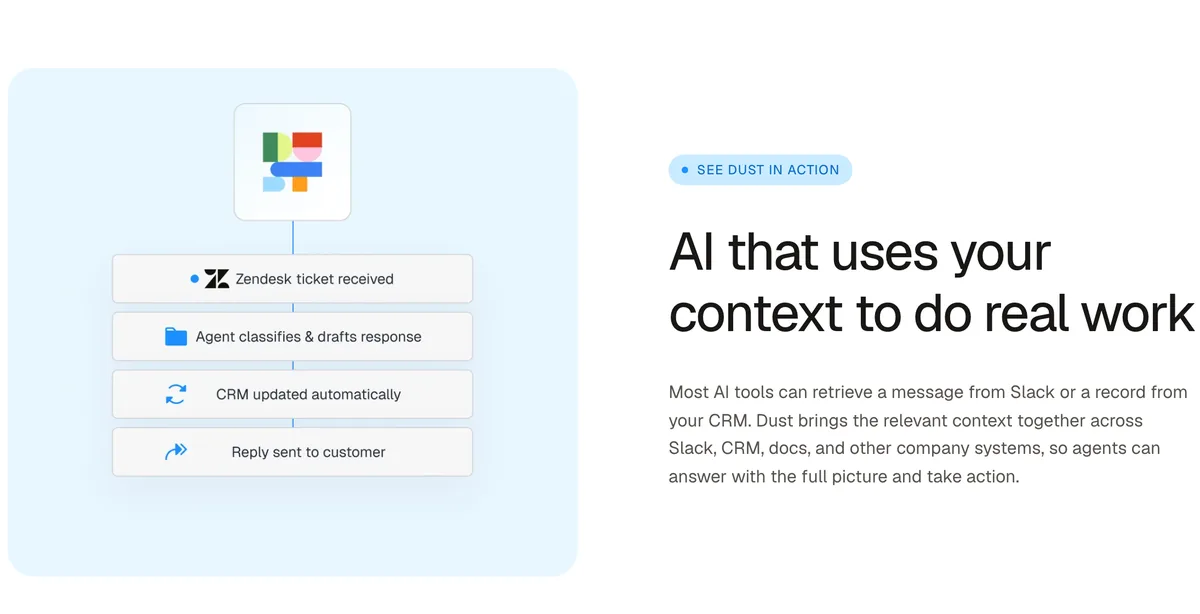
Dust: Dust example flow where a Zendesk ticket is classified, the CRM is updated and a reply is sent to the customer. Source: dust.tt, checked November 9, 2026.
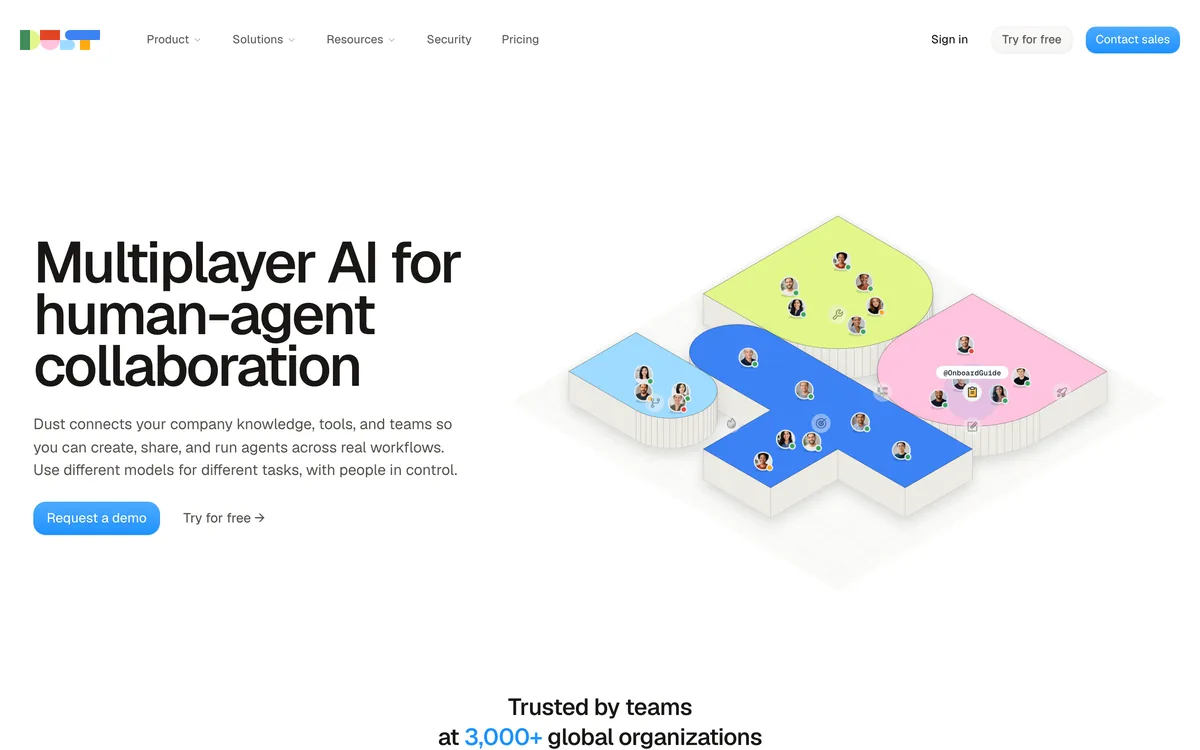
Dust describes itself as multiplayer AI for human and agent collaboration13. Its home page says it connects company knowledge, tools and teams so that people can create, share and run agents across real workflows2. On a CIO's map of the estate, Dust is a workspace that spans all three boxes in a compact form: a default assistant, retrieval over connected company data, and agents that teams build and share themselves.
This site ranks Dust seventh. Its documentation is unusually clear on permissions, audit logs and API controls, it publishes per seat prices, and it offers US or EU data residency and a single tenant option. It ranks below the others because its connector count is smaller, its Business plan is sized for teams of up to 100 people, and its model of agent building is self service, with no delivery team described on the pages used here. Each point is sourced below.
Dust's documentation, trust and pricing pages, read on 8 November 2026, are the only sources here, and the number after each fact identifies its line in the fact file.
The company
Dust's privacy policy names the operating entity as Permutation Labs, at an address in Paris, France14. By its own count, Dust is in use at upward of 3,000 organizations worldwide15. Customer quotes on the same page include Clay's go to market engineering lead, who calls Dust the most impactful software the company has adopted since building Clay16, and the chief executive of Assembled, who says the company bet on Dust because the team was exceptional17.
The home page also makes a statement about how Dust itself works: it says the company used to do the work and now builds the agents that do it18. It addresses its message to AI Operators across departments who use Dust to rewire how their companies work19.
Where Dust sits in the estate
On the three box map, Dust covers the assistant box through a default agent. Every workspace includes the @dust agent1. It covers the search box through retrieval over connected sources. Search runs semantic retrieval across selected data sources3, and Dust brings context together across Slack, CRM, docs and other company systems20. It covers the agent box through custom agents. Dust defines an agent as a model combined with instructions, tools and company knowledge21, and custom agents can answer support questions or generate SQL from company data22.
Dust is model agnostic. Its documentation says it runs on the top frontier models on the market along with open source models23, and the home page says agents can be built with more than 20 frontier and open source models24. Users who do not want to pick a model can leave it to one of three automatic tiers, labeled Basic, Standard and Premium in the picker25.
For a CIO, Dust is closest to a shared AI workspace that teams adopt and extend on their own. The home page says teams get the flexibility to build and adapt agents with the security and control enterprise AI requires26.
How the product works
Dust gives agents several ways to use data. Besides semantic search3, an include data mode loads documents exhaustively, most recent first, up to the context window limit27. A query tables mode turns a question into a SQL query against structured data28. An extract data mode pulls structured information that follows a schema the customer defines29. These are concrete, well defined modes, and they help a builder choose the right one for each task.
Data reaches Dust in several forms. Once a source is connected, changes flow in without manual refreshes and normally show up in Dust a few minutes later30. Administrators control what is synced, down to specific Slack channels, Google Drive folders or Notion pages4. Public websites are ingested with the Dust web crawler31. Folders hold static documents and tables, uploaded by hand or by API32. Custom connections can be built with the Dust API or ready made scripts33.
Collaboration is built in. A single thread can hold more than one agent at a time34, and sharing that thread brings colleagues into the same working session with them35. Tools let agents act on third party systems such as Slack, Salesforce, Gmail and HubSpot through MCP servers5.
For developers, the platform supports building on Dust programmatically through the Dust API36. The GitHub organization lists an official Dust CLI for talking to agents from the terminal37, a GitHub Action to send data to Dust38 and an n8n node for using Dust agents39. The core platform repository linked from the home page40 returned a not found response when checked, so its code was not reviewed41.
From idea to production
Dust is built for self service. The pricing page offers a self serve plan for teams, or a conversation with Dust about enterprise deployment, governance and support11. API keys are created under Admin, Developers, in the API keys tab42. A new key stays visible for 10 minutes only43. Read only keys can create conversations and read agents and data sources44, while keys that need to write, for example to upload files, are scoped to specific Spaces45. A monthly cap on a key is optional46.
Agents reach users where they work. Integrations bring agents into the tools a team already uses and let other apps call them47. Dust in Slack calls agents from channels, threads and direct messages48, and Dust in Teams does the same in Microsoft Teams49. A browser extension runs agents in a side panel with the current tab as context50. A Google Sheets add on brings agents into spreadsheets51, and Dust in Zendesk brings them into the support desk52. Developers working in an IDE or another AI assistant can reach their Dust agents through the Dust MCP Server53.
Automation tools can trigger agents. A Make scenario54, an n8n workflow55 or a Power Automate flow56 can each run a Dust agent. Agents can also run on a schedule or on events from GitHub, Jira, Linear, Zendesk, Fathom or a custom webhook without a third party tool57.
A delivery team that builds agents with the customer, or an implementation timeline, does not appear in the Dust facts gathered for this profile. Enterprise support carries priority with an SLA12.
Integrations
The connector count on the home page is 70 plus, and the named examples mix collaboration tools such as Slack, Notion and Google Drive with GitHub, Salesforce and Zendesk58. The Business plan connects Slack, Notion, GitHub and Drive plus 20 more, or any tool through MCP59. The Enterprise plan includes unlimited connectors and MCP servers60.
Among the vendors on this site that publish a count, it is the smallest, next to more than 4,000 for Nexus61, more than 1,500 for Copilot Studio62 and 275 or more for Glean63. MCP support559 widens that reach, and a company with an ERP or a core industry system should test how an agent will act on it.
Security and certifications
Dust's home page says it is SOC 2 Type II certified64. Its security page says it is GDPR compliant and SOC 2 Type II certified, and that it enables HIPAA compliance65. ISO 27001 is not named on the Dust pages saved for this profile. Data is encrypted with AES 256 at rest and TLS in transit66.
The data commitments are direct. The security page says customer data is never used to train models67 and that no data is stored by third party model providers68. The privacy policy says foundational model providers, naming OpenAI, Anthropic, Mistral, Google and Fireworks, are prohibited from using customer and personal data for model training69, and that model providers apply a zero data retention policy so customer content is not logged for human review70. Dust seeks data processing agreements with its service providers71, and personal data is stored in line with applicable data protection laws72. A trust center exists, though only its title loaded in the saved copy73.
Deployment and data location
Dust offers data residency in the US or EU74 and a dedicated single tenant deployment75; the Enterprise plan lists both76. On the security page the same choice is framed as a regulatory one, with hosting placed in the US or the EU as the customer's rules require77. Custom data retention policies are listed78, and customers control which data Dust ingests from each source79.
Governance and permissions
Governance is one of Dust's strongest areas, and its documentation is precise. Dust gives each workspace three roles and a set of granular permissions80. Admins have full workspace administration access81. Managers are delegated administrators82 who can manage membership, credit limits and credit requests for selected groups83, but do not receive billing or security features by default84, and the Manager role alone does not open Security settings or audit logs85. Members have no administrative access by default86. The security page describes the same structure as user, builder and admin roles87.
Permissions go to groups88 and are additive across the groups a person belongs to8. Groups can be provisioned from the identity provider through SCIM7 or created by hand in Dust89. Single sign on with the customer's identity provider is offered90, and the Business plan lists SSO with Okta, Entra ID and Jumpcloud91. Joiners and leavers are handled automatically, with accounts created and removed without manual tickets92. Private spaces restrict sensitive data by role93.
The permission model separates what agents can access from who can use them6. Its home page compresses the model into a short list, from groups synced over SCIM and overrides that need an admin, to a promise of zero privilege escalation and a set of audit logs94.
Audit logs are well specified. They give security and compliance teams a tamper evident, time ordered record of every significant action95, and they distinguish between actions by human users and actions by AI agents96. For a CIO who needs to show what agents did, that distinction is valuable. Logs can stream continuously to a SIEM such as Datadog, Splunk or AWS S397. The interface offers full text search, time range filters and CSV export98. Opening the audit log viewer is itself logged99. Audit logs are available to workspace admins and to groups granted security features100.
Commercial model
Dust publishes its seat prices. On the Business plan, a Free tier includes 500 lifetime credits101. A Pro seat is 24 euros102 with 8,000 credits per seat per month103, and a Max seat is 120 euros104 with 40,000 credits per seat per month105. Those figures are shown before VAT106, and a buyer who commits to a yearly term pays a fifth less107. Upgrading from Free to Pro or Max grants the full credit allocation at once108.
On Enterprise, seat based plans offer Pro or Max seats on an annual basis only109. A pooled plan uses a single Workspace seat type with a shared credit pool110. Enterprise includes custom legal terms, including an MSA and DPA111, and it is described as the plan for AI at scale112. Seat type and workspace role are decoupled, which allows combinations such as an administrator on a Free seat working next to an ordinary member on Pro113.
For a US buyer, the euro pricing is a small practical point to settle with finance.
Stated limits
Dust's documentation states its limits plainly. Dust sizes its Business plan for a team, setting the upper bound at 100 people9. Free seats are limited to 5 members in total114, are a one time lifetime allocation that does not renew115, and can be held by a member only once116. Unassigned members can open the workspace but cannot post or interact with agents until a seat is assigned117. Members who reach their credit limit are blocked from sending messages118.
API keys have their own rules. When a key hits the monthly ceiling set for it, every further call fails until an administrator lifts that ceiling or usage falls back119. After creation, only the cap can change120; changing scope or Spaces requires a new key and revoking the old one121, and revoking cannot be undone122. On legacy plans, the per key cap is a dollar amount123. Audit logs are available only on the Enterprise plan10.
How it compares with Nexus
Dust and Nexus both put agents in the tools employees use. Dust runs in Slack, Teams, Zendesk and the browser48495250; Nexus covers a wider set of surfaces, since its agents reach users by phone, WhatsApp and email as well as Slack, Teams and the web124. Both are model agnostic, Dust with more than 20 models24 and Nexus with swappable providers125. Dust publishes more governance detail, notably its role model80 and audit logs that separate human and agent actions96, and it states US or EU residency74, where Nexus's hosting options are not publicly stated on the pages we opened.
Nexus ranks ahead on the work that matters most for a CIO's agent layer. On delivery the gap is wide, because a Nexus engineer works through the first procedure side by side with the business126 and that first agent is in production four weeks into a three month proof of concept127; Dust's model is self serve11. Nexus reports more than 4,000 integrations with bidirectional reach into CRMs and ERPs128129, against Dust's 70 or more connectors58. Nexus attaches a business KPI to every agent from day one130 and prices per role automated with no consultant time billed127, while Dust prices by seat and credit103105.
Verdict
Dust is a well documented, well governed workspace for teams that want to build and share their own agents, with clear audit logging, published prices and a choice of US or EU hosting. It ranks seventh on a CIO's estate map because its published connector count is the smallest among vendors here that publish one58, its Business plan is sized for teams of up to 1009, and no delivery team appears in the facts gathered for it. A CIO with a strong internal community of builders could pilot it with one department and measure adoption, and should test how its agents reach the systems of record that matter most.
What buyers should test
We read dated supplier documentation and identify the product, edition and limits each statement covers. We separate those statements from our analysis and buying questions. We label information supplied directly by a company. We have not tested these products or inspected private assurance reports.
The job it does
Documented
Dust includes a default assistant and supports agents built around company knowledge and tools.1,2Based on supplier documents checked November 8, 2026. We have not tested the described features.
Evidence
Show one request, the information it needs and the finished result. Mark each step the product owns.
Finding the right source
Documented
Dust documents semantic search over selected sources, with administrators choosing synced channels, folders and pages.3,4Based on supplier documents checked November 8, 2026. We have not tested the described features.
Evidence
Who checks source freshness and whether a new group should receive the same data?
Use a current document, an outdated copy and a restricted record. Check the source links and access rules.
Changing a record
Partly documented
Dust documents tools acting on services including Salesforce, Gmail and HubSpot through MCP servers.5Based on supplier documents checked November 8, 2026. We have not tested the described features.
Evidence
What makes your selected action wait for approval, and who can change that rule?
Name each read and write operation, the connected account and the approval step. Ask to see a refused action.
Accounts and access
Documented
Dust separates what agents can access from who may use them. Identity-provider groups sync through SCIM, and group permissions add together.6,7,8Based on supplier documents checked November 8, 2026. We have not tested the described features.
Evidence
Could another group membership restore access you intended to remove?
Trace the user, agent and connection through one task. Remove access and check what happens next.
Who runs it
Partly documented
Dust offers self-serve team plans and enterprise discussions covering deployment, governance and support. Enterprise lists priority support with an SLA.11,12Based on supplier documents checked November 8, 2026. We have not tested the described features.
Evidence
Who will build the agent and handle failures during your operating hours?
Business is described for teams up to 100 people. Audit logs require Enterprise.9,10
Get named customer and supplier responsibilities, a launch plan, support terms and a quote for the intended use.
Dust's GitHub organization lists the official Dust CLI as a public repository. github.com/dust-tt, checked November 8, 2026.
A GitHub Action sends data to Dust. github.com/dust-tt, checked November 8, 2026.
An n8n node lets people use Dust agents. github.com/dust-tt, checked November 8, 2026.
Dust's homepage links to a GitHub repository at github.com/dust-tt/dust. dust.tt, checked November 8, 2026.
The core Dust platform repository at github.com/dust-tt/dust returned HTTP 404 when checked, so its code was not reviewed. github.com/dust-tt/dust, checked November 8, 2026.
Connectors page: 275+ out-of-the-box connectors across enterprise apps. glean.com/platform/connectors, checked November 8, 2026.
Homepage lists SOC 2 Type II certification. dust.tt, checked November 8, 2026.
Security page says Dust is GDPR compliant and SOC 2 Type II certified, and enables HIPAA compliance. dust.tt/security, checked November 8, 2026.
Customer data is encrypted with AES-256 at rest and TLS in transit. dust.tt/security, checked November 8, 2026.
Security page says customer data is never used to train models. dust.tt/security, checked November 8, 2026.
No data is stored by third-party model providers (zero data retention). dust.tt/security, checked November 8, 2026.
Privacy policy says foundational model providers are prohibited from using customer and personal data for model training. dust.tt/privacy, checked November 8, 2026.
Model providers are said to apply a zero data retention policy, so customer content is not logged for human review. dust.tt/privacy, checked November 8, 2026.
Privacy policy says Dust seeks data processing agreements with its service providers. dust.tt/privacy, checked November 8, 2026.
Privacy policy says personal data is stored in line with applicable data protection laws. dust.tt/privacy, checked November 8, 2026.
The trust center page loads only its title in the saved copy. trust.dust.com, checked November 8, 2026.
Dust offers data residency in the US or EU. dust.tt, checked November 8, 2026.
Dust offers a dedicated single-tenant deployment. dust.tt, checked November 8, 2026.
Enterprise plan includes US and EU data residency and single-tenant deployment. dust.tt/pricing, checked November 8, 2026.
Regional hosting in the EU or US is offered to meet regulatory needs. dust.tt/security, checked November 8, 2026.
Homepage lists custom data retention policies. dust.tt, checked November 8, 2026.
Customers choose which data Dust ingests from each source. dust.tt/security, checked November 8, 2026.