Tarnfield Row helps CIOs make sense of enterprise AI purchases: what each tool does, where products overlap and who will run the work. Last updated:
Our review
Google Gemini Enterprise
A broad starting point for teams already comfortable with Google Cloud. Separate the employee app from the platform used to build agents before comparing scope, responsibilities or price.1,2,4Google describes several related tools and familiar account controls, but its app and Agent Platform are separate purchases.
Best for
A Google Cloud team planning search, an employee assistant and custom agents together.
Avoid when
The proposal treats the app subscription as the entire cost or assumes all editions and regions have the same controls.
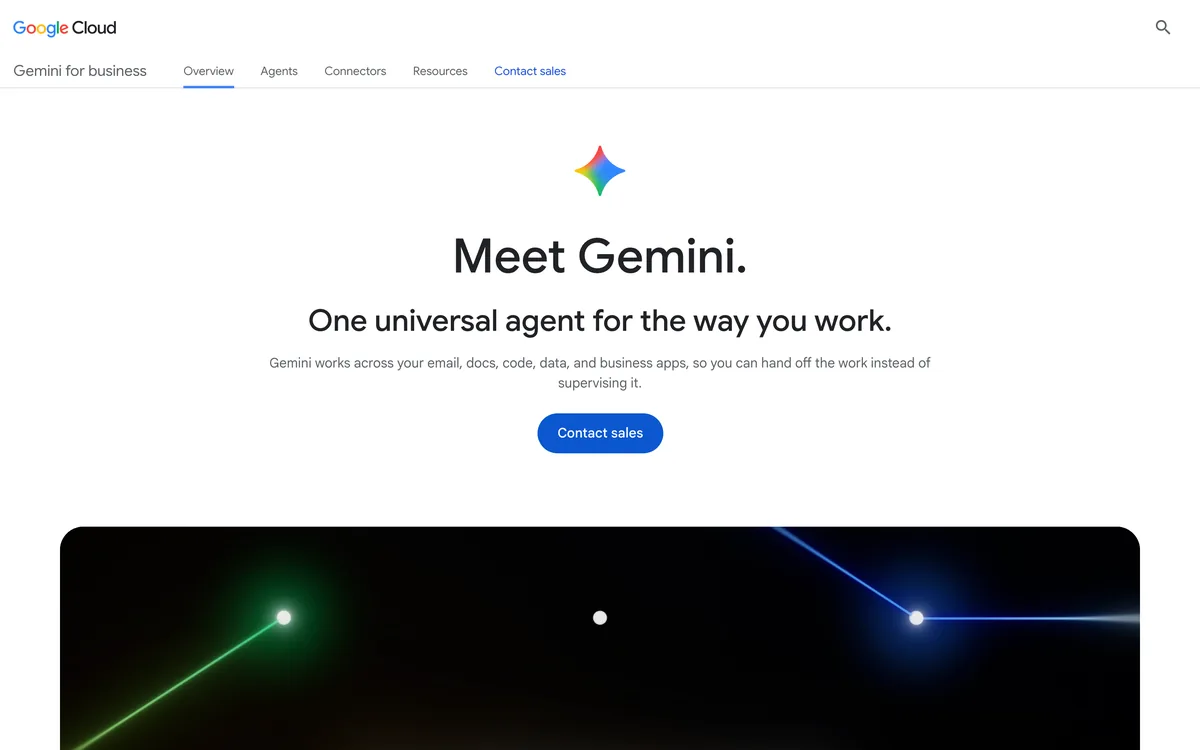
Google Gemini Enterprise: Gemini Enterprise page on Google Cloud with the headline Meet Gemini and a contact sales button. Source: cloud.google.com/gemini-enterprise, checked November 9, 2026.
If a CIO wanted one vendor to label all three boxes on the estate map at once, Google has already written the caption. Its documentation sums up Gemini Enterprise in a single line as intranet search, AI assistant and agentic platform together1. The FAQ pitches the app as a way to bring Google's best AI to every employee through an advanced agentic platform13. Breadth under one name is the main reason a single vendor buyer will look here first.
Gemini Enterprise is third in this ranking. Out of the box it spans more of the map than most rivals, and few vendors publish as much security detail. Two things hold it below Nexus and Copilot Studio: the distance between a licensed workforce and a production agent on a business process, and how little of its enterprise seat pricing is public.
This profile was assembled on 8 November 2026 from Google Cloud pages that anyone can open, and each fact is followed by the number of its line in the fact file. Some Google addresses, the pricing page among them, served a not found page that day9, and they are used only to record that.
Two contracts under one brand
Before anything else, a CIO should know that Google treats the app and the Gemini Enterprise Agent Platform as separate purchases2. The platform, in Google's own phrase, is what Vertex AI has evolved into14. Billing follows the split: the app charges a monthly fee for each seat and needs a live user license11, and the platform bills by consumption as it is used12.
On the estate map the split is tidy. The app serves employees in the assistant and search boxes, and the platform is the engineering bench where agents are built on Google tooling. The two meet when Standard or Plus customers push agents made with the platform or the Agent Development Kit straight into the app15. Agents from outside can join over the Agent to Agent protocol16, and an Agent Marketplace carries partner built options17.
Editions vary by audience18. Business is pitched at small firms and at teams of no more than 30019. A firm that outgrows Business and steps up to Standard or Plus gains a bigger quota and an unlimited seat count, along with third party agents and Gemini Code Assist20. Frontline workers have an edition of their own21, which Standard and Plus customers buy as an add on22. Government bodies and educational institutions sit outside the normal ladder, with packages such as Gemini for Government shaped for them23. Documentation is split too, with Business sent to a separate help center while the main docs cover Standard, Plus, Frontline and pay as you go24.
What employees see
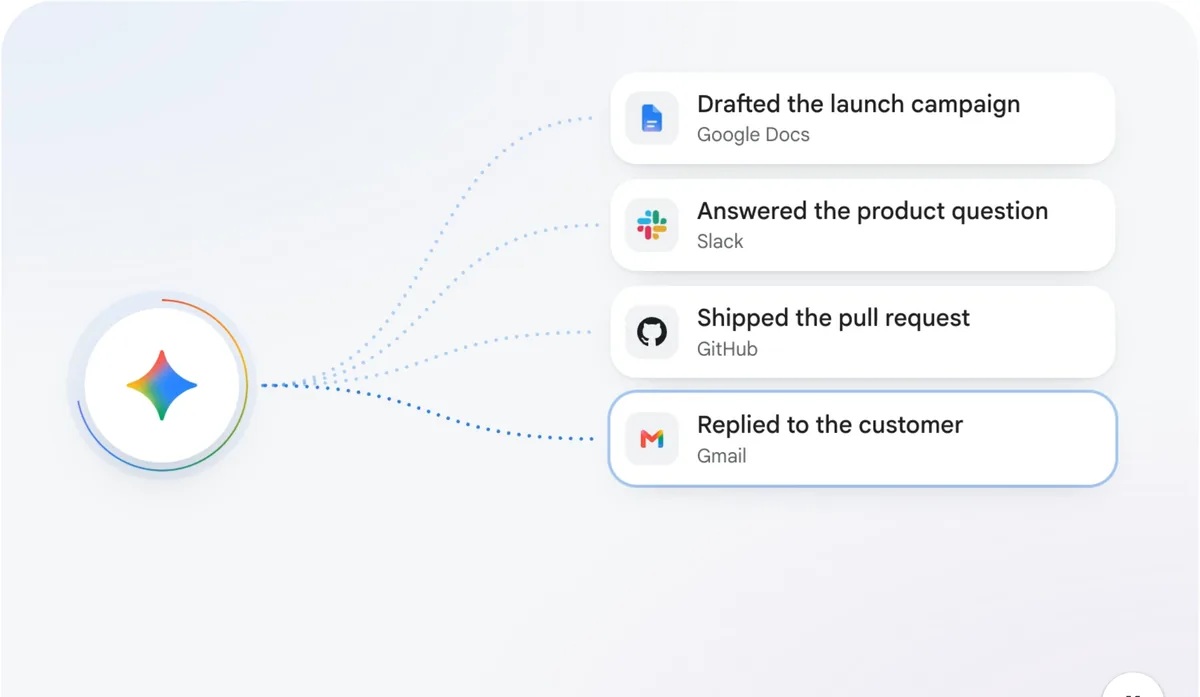
Google Gemini Enterprise: Gemini agent linked to finished tasks in Google Docs, Slack, GitHub and Gmail. Source: cloud.google.com/gemini-enterprise, checked November 9, 2026.
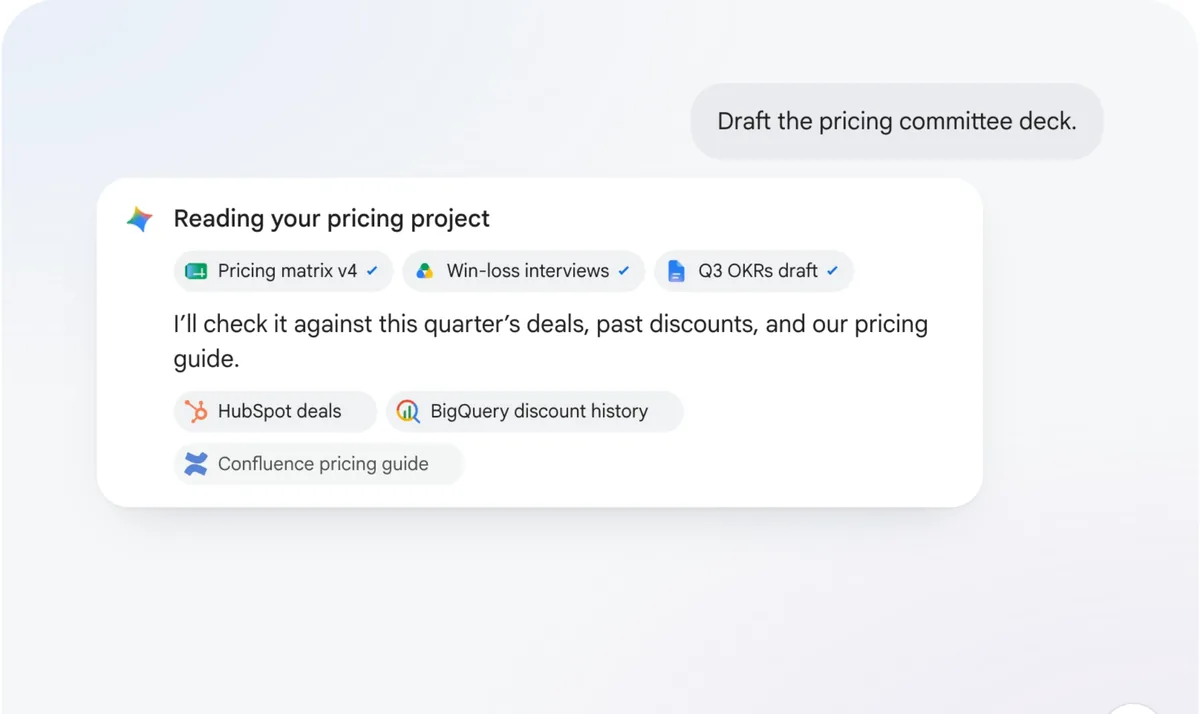
Search in the app respects permissions, so each person reaches only the enterprise information they are cleared for25. Connectors for widely used third party tools come prebuilt26, and the docs name Confluence, Jira, SharePoint and ServiceNow as examples3. For a Workspace shop the most useful connector set is the native one, where Gmail, Drive, Groups and Calendar are synced as they change27. Small teams on the Business edition can link Microsoft 365, Google Workspace, HubSpot and Notion28, and Data Cloud users get a federated connector for BigQuery29.
Several agents ship ready to use. Deep Research digs into complex subjects for the employee30, and Standard and Plus customers can preview a Data Insights Agent31. Alongside the app sits Gemini Notebook Enterprise, a research and knowledge assistant32, sold by subscription in quantities up to 5,000 licenses33.
The FAQ pictures the typical user as a knowledge worker, whether in finance, HR, marketing, sales or IT and engineering34. A sample prompt asks for a summary of the previous year's strongest campaigns35. The Business pages suggest using it to track stock and automate purchase orders36, to write customer messages informed by Google Search37 and to bring new joiners up to speed through Gemini Notebook38.
The agent bench
Employees who want their own agent get a no code workbench in the app10. The more advanced agent work happens on the platform, where Google's governance pages treat each agent as a managed identity. A SPIFFE ID is issued to every agent5, Agent Gateway funnels agent traffic in and out39, and Model Armor checks prompts and tool output as they pass, to stop injection attempts40. Every edition of the app carries Model Armor41. Policies for tool use are written as plain language rules6.
Judged as a design for running many agents under control, this is mature work. None of the Google facts gathered for this profile describes Google staff building a first production agent with a business team, though. What is documented is administration, and the build rests with the customer or a partner.
Licensing before launch
Rollout starts in billing. An edition is bought for a billing account42, licenses are then parceled out to projects and locations43, and assignment may run automatically or be done manually44. Planning matters here because a license cannot float: it is bound to a single Cloud project and location45, and the subscription it came from is bound to a single billing account46. Seats can be bought month to month or for a year47, within a cap the console enforces on seat quantity48. No license should be handed out before the user has been granted the Gemini Enterprise User role or higher49.
For the Business edition, the steps shrink. Signing up needs only a work email address50, there are no project numbers or project level IAM roles to look after51, and the service runs on the web at business.gemini.google52.
Trying before buying costs nothing. Standard and Plus can each be run free for a 30 day spell53, the landing page lets a buyer start a 30 day Plus trial without talking to sales54, and Business has its own 30 day trial55.
The Google pages used here give no implementation timeline and name no delivery team. Licensing gets employees into the app; turning a business process into a production agent remains a project the customer has to plan and staff.
Security and data commitments
Google's security material is among the fullest on this site. A compliance officer reading the certifications page, which speaks for Standard, Plus and Notebook Enterprise56, will find FedRAMP and HIPAA on it next to PCI DSS, ISO 27001 and the three SOC reports57. Customers may bring their own keys58, through Cloud KMS on Standard and Plus59, or hold them outside Google with an external key manager60. Cloud IAM confines access to provisioned users and admins61, and access rules at the level of each document are enforced to limit leakage62.
On training, the commitment is unambiguous: prompts, responses and connected company data stay out of Google's foundation model training6364, and Business customers get the same promise65. Isolation is drawn at the project boundary, so one tenant's material stays inside the Cloud project it belongs to66. Data a user asks to delete is gone within 60 days67. On the platform side, Google says it needs prior permission before training or tuning any model on customer data68. Google does not record request and response pairs unless a customer turns that feature on69; grounding through Google Search keeps its logs for as long as three days70, and Models as a Service holds customer data for limited periods71.
Location is a menu with three entries: US, EU or global72, and Standard and Plus customers pick the region that suits them73. Auditors get two further tools in the enterprise editions, Cloud Audit Logs and Access Transparency74. Sensitive Data Protection can keep sensitive content from being pulled in or indexed through connectors75, and it runs in the global, EU and US multi regions76. Federated Data Cloud queries leave the data where it already sits77.
Central control
Google frames the app as one pane of glass from which every team's agents are governed78. Day to day control in the larger editions rests on three things a Google Cloud team already knows: IAM roles, single sign on via Workforce Identity Federation, and whatever access lists each source system holds4. Workforce Identity Federation is also Google's advice for third party connectors79. Agent identities get Context Aware Access by default80, and a per user cap on consumption can be switched on81. Smaller teams on Business have a lighter console, where an admin can change who is on the team and which connectors it may reach82.
Inside a VPC Service Controls perimeter, every Data Cloud connector must be allowed by an organization policy constraint83, and without that approval no data store can be created84. It is a deliberate gate, and it puts the security team in the loop for each new source.
Price visibility
Only one enterprise price appears on the pages we opened: Business from 21 dollars a seat each month85. Standard and Plus seat prices are not publicly stated on the pages we opened, and the pricing page itself failed to load real content on the check date9.
Consumption billing is clearer. A pay as you go subscription carries no license fee86 and is invoiced monthly on usage87. Calls to partner models land on the same metered bill88, accounts billed online through self service may now prepay with credits89, and quotas for storage and indexing form one shared pool per project and location90.
For a budget holder, this means two lines and two forecasts: seats for the app, and metered usage for the platform. Each is predictable in its own way, and neither tells the CIO what one completed outcome will cost.
Documented ceilings
Google is open about its limits. A Standard license allows 160 Assistant queries and 5 images each day91, while Plus allows 200 queries per license per day92. Because quotas other than storage and indexing are pooled at edition level93, heavy users draw down the same allowance as light ones. Code Assist entitlements bundled with existing Standard and Plus subscriptions stop on March 31, 202794, a date for the renewal calendar.
Some limits reach into security architecture. A network team used to placing its own controls in front of a service cannot do so here, since the security overview rules that out for this software as a service product95. In the global region, customer managed keys and Access Transparency are unavailable7. Third party connectors talk to public endpoints beyond Google's network8. Data protection also has gaps that the docs spell out: older stores built on Cloud Storage, BigQuery or websites fall outside its content policies96, and an encrypted Microsoft document passes through without a content scan97.
All of this is published, which is exactly what an enterprise architect needs before a design review.
Gemini Enterprise beside Nexus
The assistant, search and agent tooling all carry the Gemini Enterprise name1. Google also names more certifications57 and more data location options72 than Nexus publishes.
Nexus leads on the hardest box. A Nexus engineer builds the first procedure with the business and runs it in the customer's own tools98, and the first agent goes live in 4 weeks inside a 3 month proof of concept99, where Google documents licensing and administration4243 and leaves the production build to the buyer. On price, Nexus charges per role automated and bills no consultant hours99, while Standard and Plus seat prices are not publicly stated on the pages we opened9. On reach, Nexus reports more than 4,000 integrations100, and Google names its prebuilt connectors one by one263 with no total given in the facts gathered here. Because Nexus sits above whatever assistant a firm already runs101, a Google Workspace shop can add it without removing anything.
Verdict on Gemini Enterprise
For a firm built on Google Cloud and Workspace that wants assistant, search and agent tooling from one supplier under a familiar security model, Gemini Enterprise is a strong option. It ranks third because the app and the platform are bought and billed apart2, because enterprise seat prices are not public on the pages we opened9, and because the step from licensed users to a production agent on a core process is left to the customer. The sensible test is to run the free trial on real internal questions while scoping one agent with a measurable target, so the agent layer is judged on the same terms as the assistant.
What buyers should test
We read dated supplier documentation and identify the product, edition and limits each statement covers. We separate those statements from our analysis and buying questions. We label information supplied directly by a company. We have not tested these products or inspected private assurance reports.
The job it does
Documented
Google describes search, an assistant and agent tooling; the app and Agent Platform are separate purchases.1,2Based on supplier documents checked November 8, 2026. We have not tested the described features.
Evidence
Show one request, the information it needs and the finished result. Mark each step the product owns.
Finding the right source
Documented
Google names connectors including Confluence, Jira, SharePoint and ServiceNow, and lists source access controls for enterprise editions.3,4Based on supplier documents checked November 8, 2026. We have not tested the described features.
Evidence
Which connector, indexing mode and access rules apply to each required source?
Use a current document, an outdated copy and a restricted record. Check the source links and access rules.
Changing a record
Partly documented
Google documents a unique identity for each agent and rules governing tool use.5,6Based on supplier documents checked November 8, 2026. We have not tested the described features.
Evidence
Show a permitted change, a forbidden one and an action waiting for a human.
Name each read and write operation, the connected account and the approval step. Ask to see a refused action.
Accounts and access
Documented
Enterprise editions use IAM, Workforce Identity Federation and source access lists.4Based on supplier documents checked November 8, 2026. We have not tested the described features.
Evidence
Which controls apply to the app, custom agent and tool account separately?
The reviewed documentation excludes customer-managed keys and Access Transparency in the global region. Third-party connectors use public endpoints outside Google’s network.7,8
Trace the user, agent and connection through one task. Remove access and check what happens next.
Who runs it
Partly documented
Google offers a no-code workbench. The app bills per seat and the Agent Platform by consumption.10,11,12Based on supplier documents checked November 8, 2026. We have not tested the described features.
Evidence
Who owns the build and supports work crossing the two products?
Standard and Plus seat prices were not established by the pages captured on November 8; the pricing page returned a not-found body.9
Get named customer and supplier responsibilities, a launch plan, support terms and a quote for the intended use.
Gemini Enterprise app and Gemini Enterprise Agent Platform must be bought separately.. cloud.google.com/gemini-enterprise/faq, checked November 8, 2026.
Standard and Plus per-seat prices are not publicly stated on the pages opened. The pricing URL returned a 404 page body.. cloud.google.com/gemini-enterprise/pricing, checked November 8, 2026.
Gemini Enterprise app is described as an advanced agentic platform for every employee.. cloud.google.com/gemini-enterprise/faq, checked November 8, 2026.
Standard and Plus customers can publish their own agents built on Agent Platform or ADK.. cloud.google.com/gemini-enterprise/faq, checked November 8, 2026.
Standard and Plus add higher quota, unlimited seats, third-party agents and Gemini Code Assist.. cloud.google.com/gemini-enterprise/faq, checked November 8, 2026.
Gemini Notebook Enterprise is an AI-powered research and knowledge assistant used alongside Gemini Enterprise.. docs.cloud.google.com/gemini/enterprise/docs, checked November 8, 2026.
Knowledge workers in sales, marketing, finance, HR and IT or engineering are named as users.. cloud.google.com/gemini-enterprise/faq, checked November 8, 2026.
The Gemini Enterprise app gives one pane of glass to centrally govern all agents across teams.. cloud.google.com/gemini-enterprise/faq, checked November 8, 2026.